We’re still building up the content for this section and the best way to enjoy our churches is to visit them – but to help you get started here are some key visitor highlights from St Etheldreda and St Luke.
Key Highlights for Visitors
Welcome to St Etheldreda, a place of worship, history, and extraordinary beauty. Whether you’re here for a moment of quiet reflection or a step back through centuries of English heritage, here are some of the must-see features that visitors often find most memorable.
To discover even more, pick up a free tour leaflet inside the church. It’s a great way to explore at your own pace and uncover all the treasures we couldn’t fit here.
Stunning Stained-Glass Windows
Our church is home to several beautiful stained-glass windows, each with its own story to tell:
- Three Angels (1920)
A poignant memorial to the three sons of Lord William Cecil, all of whom lost their lives in the First World War. - William Morris Window (1894)
Dedicated to Mrs Charles Drage, this masterpiece was designed by Sir Edward Burne-Jones and crafted in the William Morris workshop. The vivid rose, green and blue colours showcase the technical brilliance of late Victorian stained glass.
Commemorative Plaques and Memorials
The walls of St Etheldreda tell the stories of notable people and events:
- King Charles I Plaque
A small metal plaque in the north transept marks the remarkable visit of King Charles I as a prisoner on 27 June 1647. - William Lamb, 2nd Viscount Melbourne (1779–1848)
A memorial on the pillar near the pulpit commemorates this former Prime Minister to both King William IV and Queen Victoria. He is buried in a nearby vault. His wife, Lady Caroline Lamb, famed for her scandalous affair with Lord Byron, rests in the churchyard.
Salisbury Chapel
A chapel rich in art, history, and national significance:
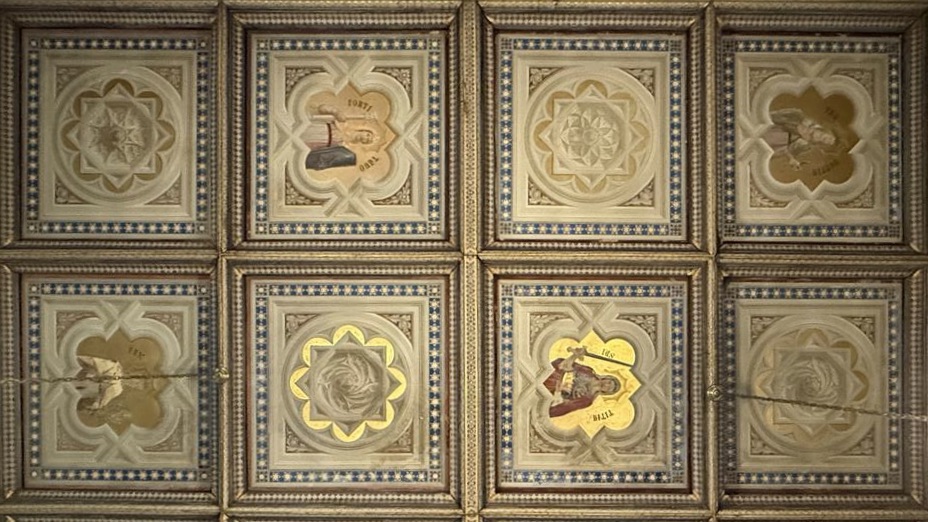
- Wall Paintings of the Four Evangelists
Recently restored works by Giulio Taldini, an Italian painter who also worked at Hatfield House. Each Evangelist is shown with their traditional symbol:
St Matthew – angel, St Mark – lion, St Luke – ox, St John – eagle. - Tomb of William Curll (d.1617)
Long-time warden of the royal estates in Hatfield, Curll served the Crown for 25 years. - Tomb of Robert Cecil, 1st Earl of Salisbury (1563–1612)
A magnificent monument created by Maximilian Colt from a model chosen by Cecil himself. He served both Queen Elizabeth I and King James I and was Lord High Treasurer. The four kneeling figures represent the Cardinal Virtues (Prudence, Justice, Fortitude, and Temperance) while the skeleton beneath reminds us that even great power is fleeting. - Effigy of a Knight (c.1160)
Possibly the oldest resident of the church, this small stone knight has stood watch for centuries. His identity remains a mystery. - Cenotaph of Robert Gascoyne-Cecil, 3rd Marquess of Salisbury (1830–1903)
A three-time Prime Minister under Queen Victoria, his impressive effigy is an exact replica of the one in Westminster Abbey. He is buried nearby.
Brocket Chapel
A peaceful corner filled with impressive monuments:
- Tomb of Sir John Brocket (c.1540–1598)
Twice Sheriff of Hertfordshire and an MP, Brocket led local men to Tilbury in 1588 to defend against the Spanish Armada. Look up to see his original helmet suspended above. - Tomb of Elizabeth Moore (d.1612) and Agnes Saunders (d.1588)
This beautifully carved monument to Sir John’s second wife and her mother is a prime example of Elizabethan funerary art. - Reade Family Monument (1760)
This elegant marble sculpture, created by renowned Flemish artist John Michael Rysbrack, marks the family’s inheritance of Brocket Hall through marriage.
There’s much more to discover at St Etheldreda. From hidden carvings to peaceful corners, every visit reveals something new. Pick up your free illustrated tour leaflet in the church to guide you further – and don’t forget your camera!
We hope you enjoy your visit.
Key Highlights for Visitors
Sitting on the edge of the roundabout in the centre of Hatfield, St Luke’s Church is a warm and welcoming space with a fascinating history rooted in local life. Originally built as a cemetery chapel, it has grown with the community it serves and is well worth a visit.
A Church with Local Roots
- Founded in 1878
Built by the 3rd Marquess of Salisbury as a cemetery chapel, St Luke opened its doors on 29 January 1878. As Hatfield’s population grew, so did the chapel’s role – expanding into a full church with a cruciform layout by 1893. - Chancel and Transepts
These additions, designed by H. T. Shillito, gave the church its present-day shape. You can still see a metal strip across the floor near the front pews, marking where the original chapel ended.
Stained Glass and Memorials
- The East Window (1924)
Designed by renowned artist Christopher Webb, this beautiful stained glass window was installed in memory of those buried in the adjoining churchyard. - Font from Spring Villas Chapel
This font, originally from the Methodist Chapel in Old Hatfield, was gifted by Mr. Tingey in time for his granddaughter’s baptism on 29 January 1939, exactly 61 years after the chapel opened. - Communal Grave for Aircraft Workers (1940)
A tragic piece of local WWII history, on 3 October 1940, a returning German pilot dropped a bomb on the De Havilland Aircraft Factory nearby. 21 men were killed, and 6 are buried in a communal grave in the churchyard. Their story is a moving reminder of the church’s connection to the lives of local people.
Gifts and Treasures from the Congregation
- Wooden Altar Panelling (1957)
Donated by Mrs. Naden to replace the original curtaining, this panelling remains a central part of the sanctuary’s character today. - Altar Silver (1961)
Crafted by local goldsmith Mr. F. Newland-Smith, the silver was donated by Mrs. H. C. Reeves and Mr. E. Tingey in memory of their parents who were lifelong members of the congregation. - Baptismal Bowl and Ewer (2005)
Hand-made for the church by David Thomas of Welham Green, it is a modern but meaningful addition. - Wrought Iron Reading Stand (2007)
Commissioned in memory of Mr. Edmund Keen, this elegant piece was made by Baddeley Rose Ltd., also based in Welham Green.
Community and Celebration
- Queen Elizabeth II’s Coronation (1953)
Fundraising events and community gifts marked the coronation, with proceeds going toward altar linens and frontals many of which are still in use. - Scout-powered Renovation (1968)
When the roof needed new tiles, 4,500 tiles from the old Memorial Hall were wheeled across the road by local scouts as part of their ‘Bob-a-Job’ week! Look up and appreciate their handiwork. - Community Embroidery (1968–72)
Members of the Trefoil Guild and others created a beautiful collection of embroidered hassocks, some from original designs by Miss M. Reeves — a personal and creative contribution still visible in the church today.
A Church That Grows with Its People
St Luke is more than its bricks and glass, it is a place shaped by the generosity, creativity, and resilience of its congregation. Whether you’re here to reflect, remember, or simply take in a bit of local heritage, you are warmly welcome.